
Thursday Could Rewrite Crypto Law
Where Crypto Capital Flows Meet Market Intelligence.
🗓️ Tuesday, May 12, 2026 | Est. read time: 8 minutes
TL;DR
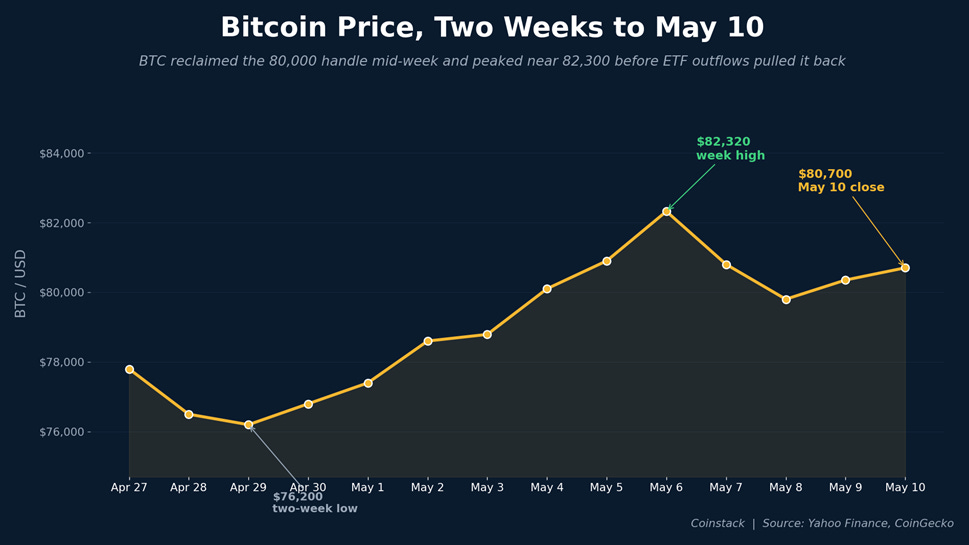
Bitcoin closed at $80,704, up 2.4%, after reclaiming $80,000 mid-week and testing $82,300.
Senate Banking confirmed the CLARITY Act markup for May 14, the first real legislative step on the US crypto market structure since January.
Strategy posted a $12.5B Q1 loss on May 5 and pivoted from ‘never sell’ to active Bitcoin balance-sheet management.
Solana led the majors at +11.0% on ETF inflows, Western Union’s USDPT launch, and the Anchorage and J.P. Morgan partnership.
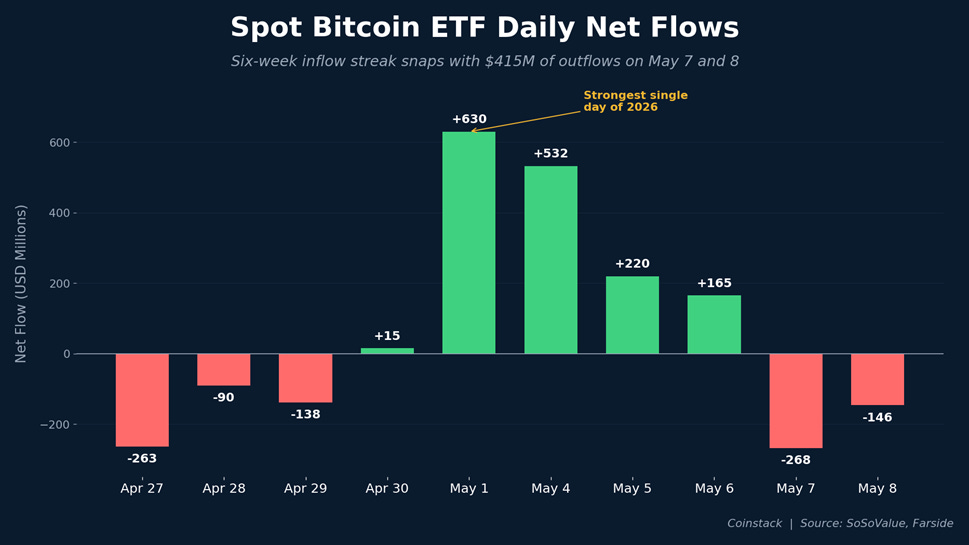
Spot Bitcoin ETFs broke a six-week inflow streak with $415 million of outflows on May 7 and 8, ending a $3.4 billion run.
Consensus Miami drew Morgan Stanley and JPMorgan as first-time sponsors, placing Wall Street and crypto-native firms on the same conference stage.
Week ahead: CLARITY Act markup May 14, full-Senate Warsh confirmation, and the CPI print May 12.
1. Weekly Opening Insight
Headline price action looked benign, with Bitcoin and the total crypto market cap each up roughly two percent. The structural reads beneath were anything but.
The Senate Banking Committee placed the CLARITY Act on the calendar for May 14, the first hard date for US market structure in five months. Strategy abandoned its absolute ‘never sell’ Bitcoin doctrine on its Q1 call. ETF flows confirmed both sides of the new regime: a $630 million single-day record inflow on May 1, followed by $415 million in two-day outflows by week’s end. Solana broke decisively higher than the other majors.
Here’s what crypto investors should understand about the week ahead…
2. Weekly Market Dashboard
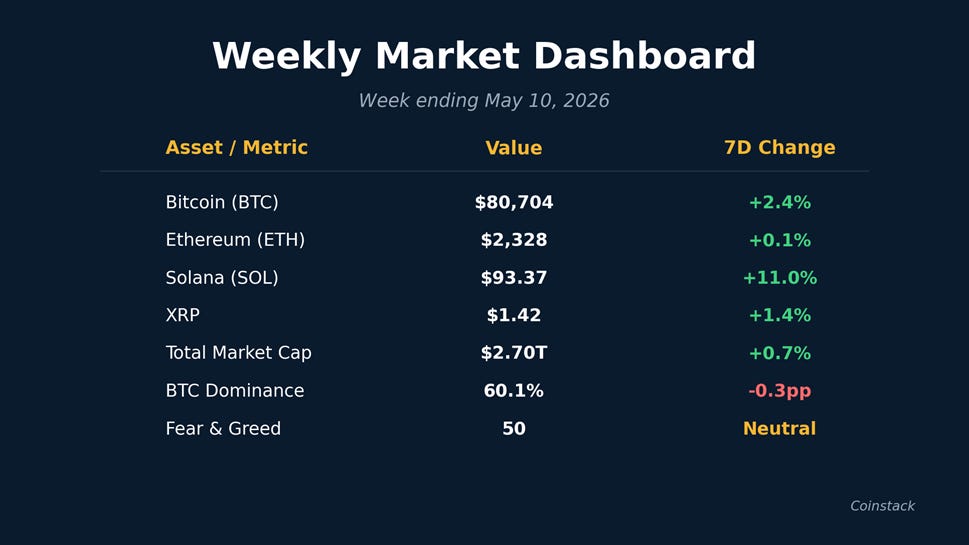
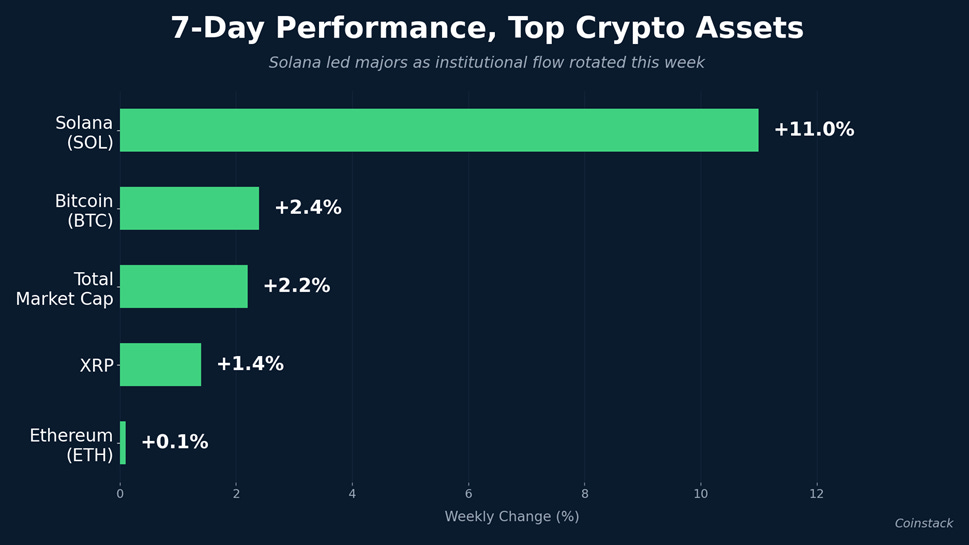
Best Performing Large-Cap: Solana (+11.0%)
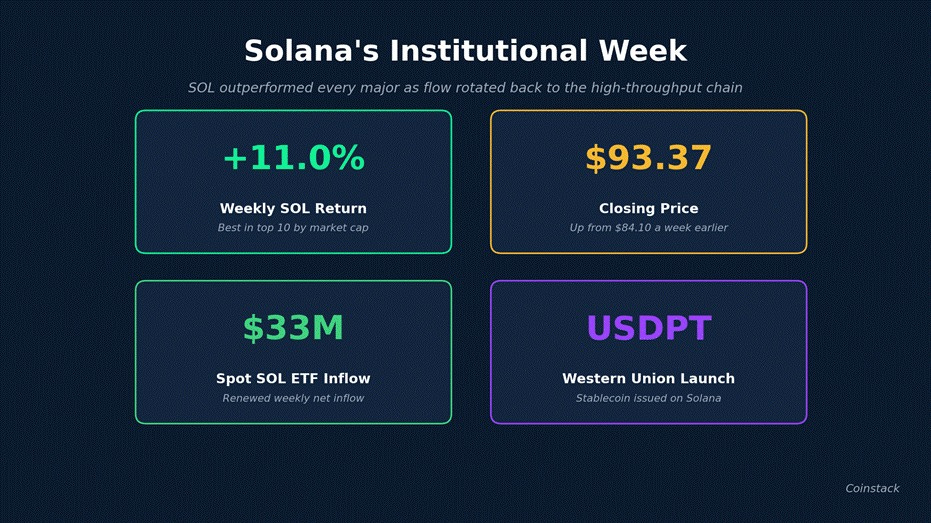
Solana closed at $93.37 after a sub-$85 print to start the week. The catalyst stack was dense: a $33 million weekly spot SOL ETF inflow, an Anchorage Digital and J.P. Morgan partnership on tokenized stablecoin reserves on Solana, the Western Union USDPT launch, and a Solana and Google Cloud AI agent payments announcement on May 5.
Worst Performing Large-Cap: Ethereum (+0.1%)
Ethereum was flat at $2,328 as spot ETH ETFs saw a $103 million outflow on May 7, and DeFi TVL dominance ticked toward a multi-year low near 53%. Capital rotated to BTC for the macro setup and to SOL for the catalyst stack.
What Drove Markets This Week
Three forces shaped the tape. CLARITY Act markup scheduling lifted the legislative bid on May 8. Strategy’s Q1 results and treasury pivot reframed the largest corporate Bitcoin position. ETF flows reversed sharply on May 7 and 8, exposing concentrated positioning.
Bitcoin Price Action: Bitcoin reclaimed the $80,000 level mid-week and tested $82,300 before pulling back slightly on ETF outflows.
3. The Big Story of the Week
Senate Banking Sets May 14 Markup, Putting the CLARITY Act Back on the Calendar
What happened
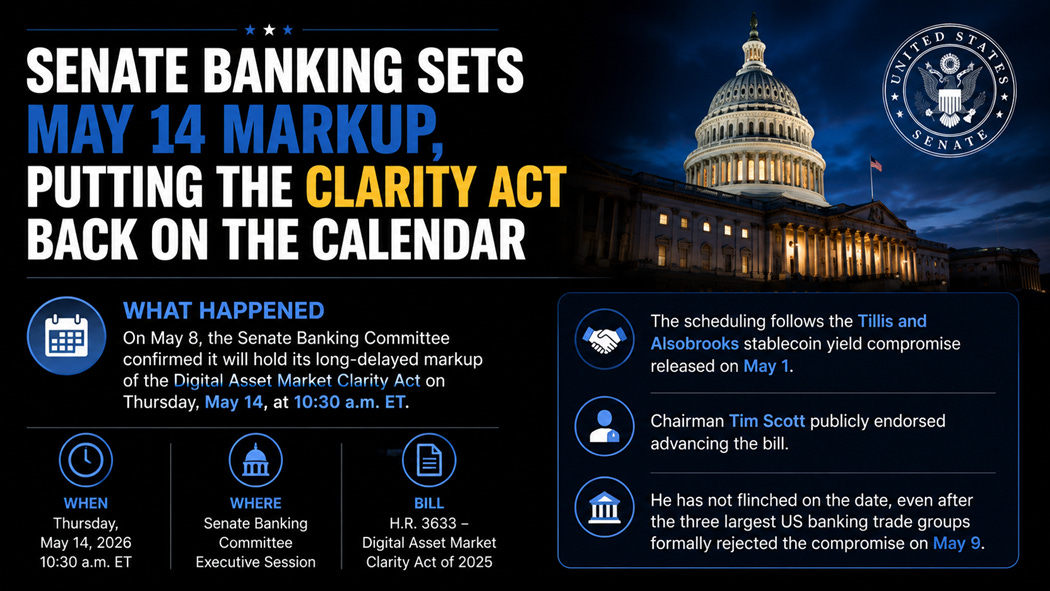
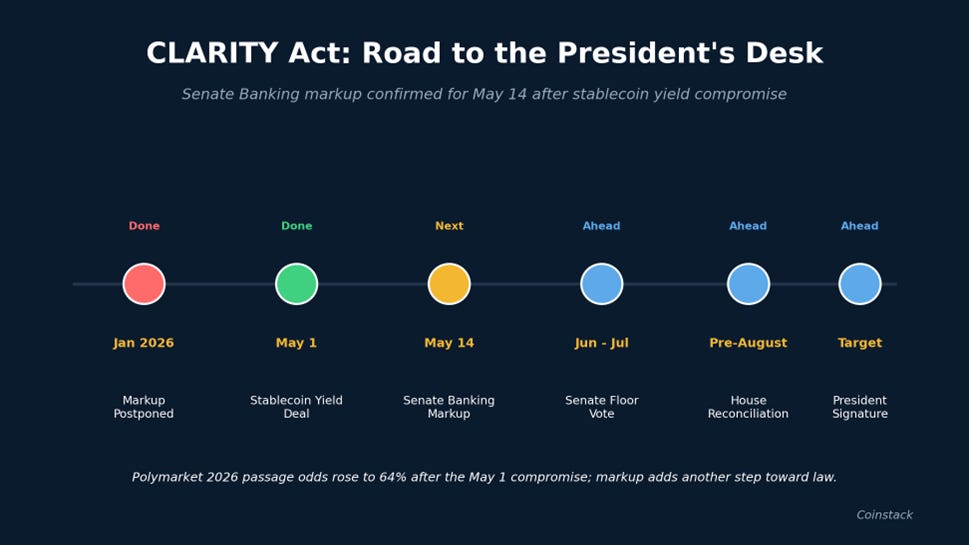
On May 8, the Senate Banking Committee confirmed it will hold its long-delayed markup of the Digital Asset Market Clarity Act on Thursday, May 14, at 10:30 a.m. ET. The scheduling follows the Tillis and Alsobrooks stablecoin yield compromise released on May 1. Chairman Tim Scott publicly endorsed advancing the bill, and has not flinched on the date, even after the three largest US banking trade groups formally rejected the compromise on May 9.
Why It Matters
The CLARITY Act has been the largest pending US crypto regulation since the GENIUS Act last summer. A successful markup clears the path for reconciliation with the Senate Agriculture version, a 60-vote floor threshold, House reconciliation, and a Presidential signature, all targeted by the White House for July 4. Polymarket odds for 2026 passage have moved into the 60-70% range, up from 46% before the May 1 compromise.
Investor Takeaway
Watch three things on Thursday:
First - Whether the markup clears the committee, particularly with Senator Grassley’s late entry on Section 1960 language affecting DeFi developers.
Second - The partisan margin: a clean bipartisan vote tightens the floor path.
Third - Equity reads: Coinbase, Circle, and Robinhood are the cleanest, with XRP and the broader altcoin tape as the crypto-native reads.
Update: The U.S. Senate Banking Committee released the latest 309-page text of the CLARITY Act on Tuesday, May 12.
4. Key Market Developments
Strategy Pivots to Active Bitcoin Management on $12.5B Q1 Loss
What Happened
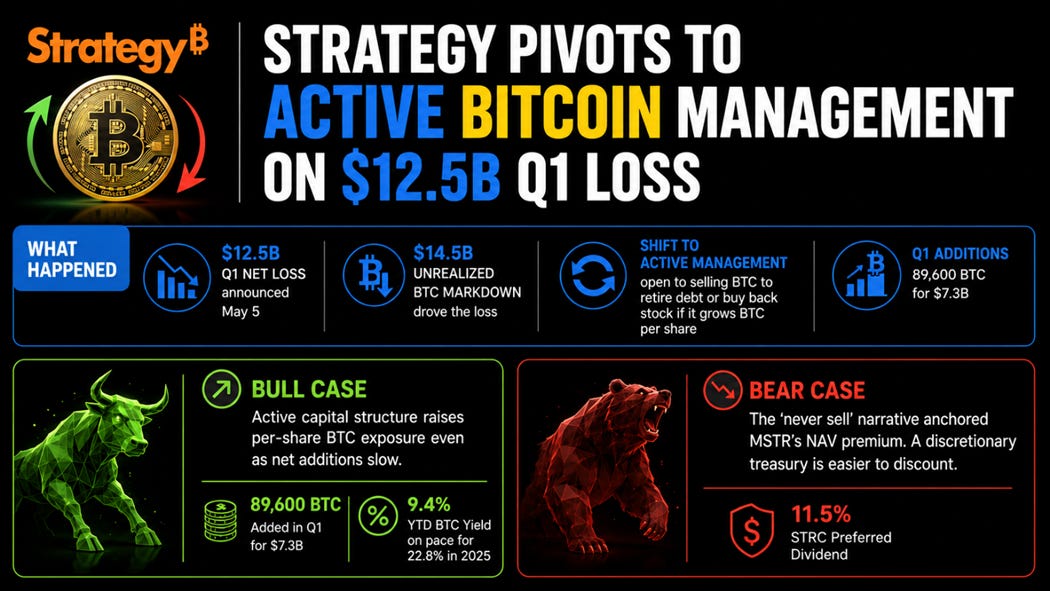
Strategy posted a $12.5 billion Q1 net loss on May 5, driven by a $14.5 billion unrealized BTC markdown. Management signaled a shift from ‘never sell’ to active balance-sheet management, open to selling BTC to retire debt or buy back stock if it grows Bitcoin per share.
Bull Case
Active capital structure raises per-share BTC exposure even as net additions slow. Q1 still added 89,600 BTC for $7.3 billion, and YTD BTC yield of 9.4% tracks 2025’s 22.8% pace.
Bear Case
The ‘never sell’ narrative anchored MSTR’s NAV premium. A discretionary treasury is easier to discount, with the STRC preferred dividend at 11.5%.
Consensus Miami Brings Wall Street and Crypto onto One Stage
What Happened
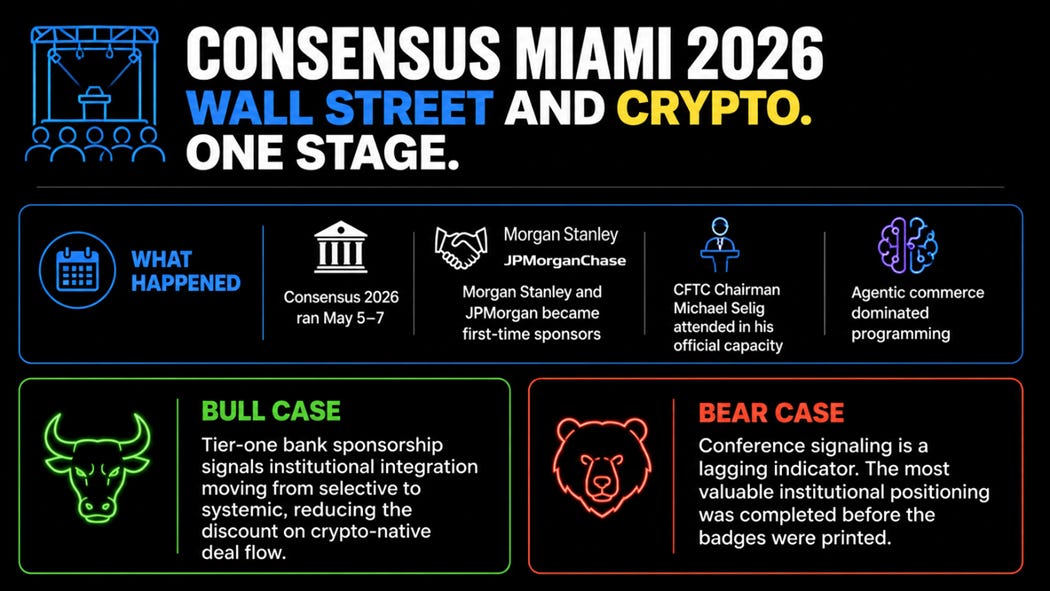
Consensus 2026 ran May 5-7, with Morgan Stanley and JPMorgan signing as first-time sponsors. CFTC Chairman Michael Selig attended in his official capacity. Agentic commerce dominated programming.
Bull Case
Tier-one bank sponsorship signals institutional integration moving from selective to systemic, reducing the discount on crypto-native deal flow.
Bear Case
Conference signaling is a lagging indicator. The most valuable institutional positioning was completed before the badges were printed.
Six-Week Bitcoin ETF Inflow Streak Snaps with $415M of Outflows
What Happened
Spot Bitcoin ETFs saw $268 million of outflows on May 7 and $146 million on May 8, breaking a six-week net inflow streak worth $3.4 billion. FBTC and IBIT led the reversal, though the weekly net was still positive at roughly $768 million.
Bull Case
A single-week pullback does not undo a six-week run. IBIT and FBTC remain the marginal price-setters, and the May 1 record showed deep demand.
Bear Case
Two-fund concentration is the bid’s vulnerability. A $1 billion-plus outflow week from IBIT would test the $78,000 to $80,000 support.
5. On-Chain Data Insight
Stablecoin Settlement Volume Surfaces in Plain Sight
The Data
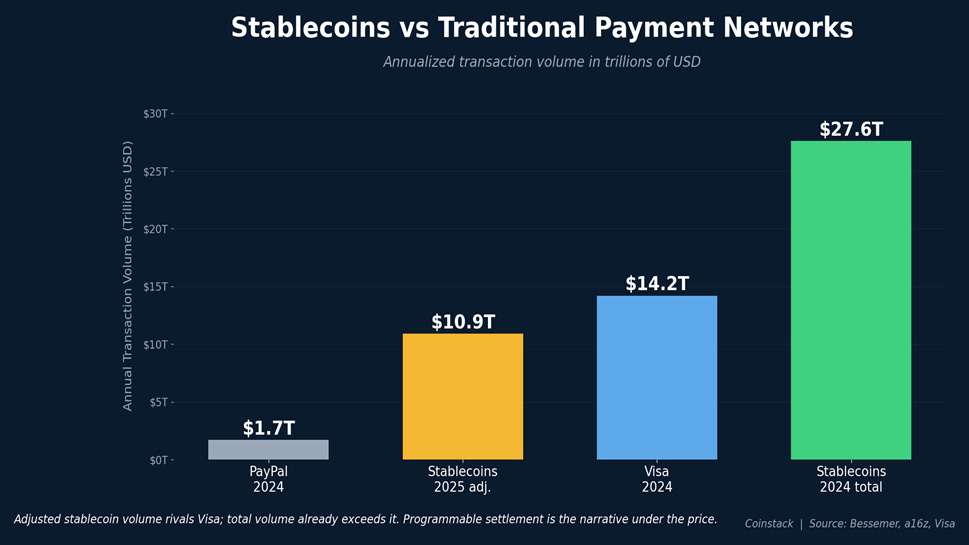
Stablecoin transaction volume reached $27.6 trillion in 2024, and adjusted non-bot volume hit $10.9 trillion in 2025. Visa reported $4.6 billion in annualized stablecoin settlement on its Q1 2026 call. Its pilot spans nine blockchains, with the run rate up 50% quarter-over-quarter to $7 billion annualized.
What it Might Signal
Stablecoins are no longer competing with crypto exchanges; they are competing with card networks. Volume has moved from ‘trading collateral’ to ‘settlement infrastructure’ fast enough that Visa, Mastercard, Stripe, and Western Union now operate within the same on-chain pipes. The CLARITY Act’s yield language draws the boundary between bank deposits and stablecoin rewards at the platform layer.
6. Narrative Watch
Agentic Commerce Moves From Theme to Plumbing
The Narrative
AI agents executing autonomous payments on stablecoin rails were the breakout theme of Consensus Miami. Coinbase processed over 50 million agent transactions in Q1. PayPal, Google Cloud, and Cloudflare each demonstrated commerce stacks where agents pay each other for compute, data, and API calls, settled in stablecoins.
Why It’s Gaining Attention
The OKX-led Agent Payments Protocol launched in late April with backing from the Ethereum Foundation, Solana, AWS, and Uniswap. Andreessen Horowitz announced a $2.2 billion crypto fund this week aimed at the crypto, AI, and TradFi overlap.
Why It Could Grow Or Fade
Growth case: Stablecoins solve the only payment problem agents have: sub-second machine-to-machine settlement without a card-network intermediary. Once agents handle even a small share of e-commerce, rails calcify around whoever standardizes first.
Fade case: Standards battles are slow. Competing protocols from Stripe, Adyen, or a bank consortium could fragment the stack before any approach scales.

7. Investment Theme of the Week
The Quiet Institutional Rotation Into Solana
Thesis
Solana is the only major asset combining a credible institutional flow story, a working ETF channel with staking yield, and a stablecoin settlement narrative. The week’s +11% return is not noise. It is the first sustained outperformance versus Bitcoin in 2026, backed by ETF inflows, major partnership announcements, and a Western Union stablecoin issuance.
Catalysts
Continued spot SOL ETF inflows holding above $30 million weekly.
Anchorage and J.P. Morgan tokenized stablecoin reserve product launch.
Alpenglow consensus upgrade scheduled for mainnet later in 2026.
Institutional positioning reported from Goldman Sachs, Morgan Stanley, and Citadel.
Risks
May seasonality on SOL averages a negative across the asset’s history.
Active addresses fell to 2.89 million from 5.01 million in February.
A broader macro risk-off would compress SOL’s beta first.
8. Smart Crypto Insight
Why Bitcoin Per Share Matters More Than Total BTC Held
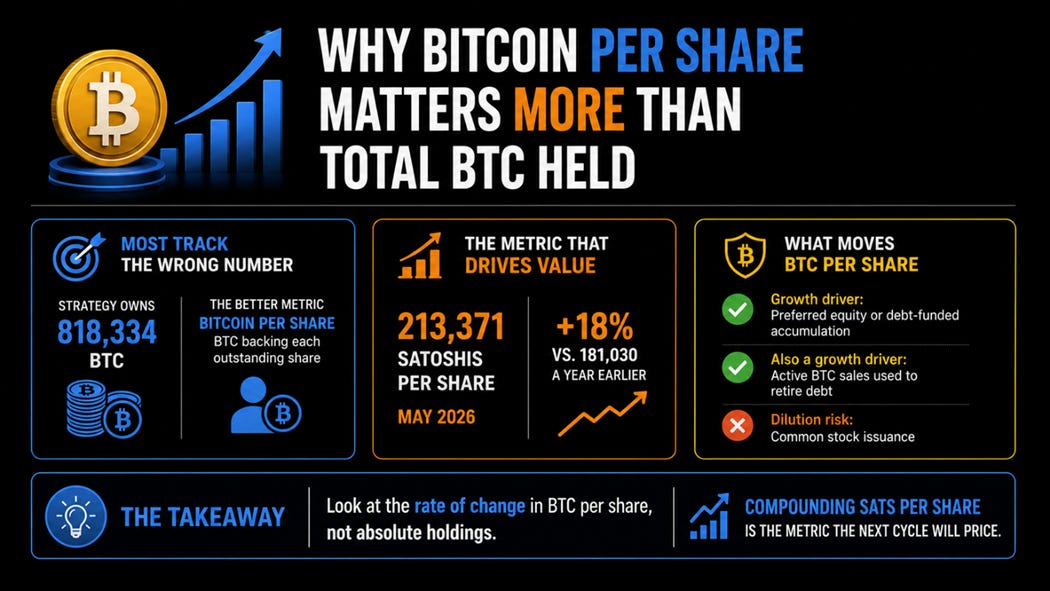
Most investors track corporate Bitcoin holdings in absolute terms. Strategy owns 818,334 BTC. The more useful metric is Bitcoin per share, the BTC backing each outstanding share. Strategy reported 213,371 satoshis per share in May 2026, up 18% from 181,030 a year earlier.
That growth, the BTC yield, justifies the NAV premium. Common stock issuance can dilute it. Preferred equity or debt-funded accumulation grows it. Active BTC sales used to retire debt also grow it, which is why this week’s pivot at Strategy is more interesting than the headline loss.
The Takeaway: Look at the rate of change in BTC per share, not absolute holdings. Compounding Sats per share is the metric that the next cycle will price.
9. Quick Hits from the Week
Andreessen Horowitz launched a $2.2B “Crypto Fund 5” focused on the convergence of crypto, AI, and traditional finance.
Western Union launched its USDPT stablecoin on Solana, linking remittance flow to on-chain settlement rails.
BNY Mellon began digital asset custody operations in Abu Dhabi, opening institutional access at the world’s largest custodian.
Project Eleven flagged 65% of Ethereum and 100% of Solana as quantum-vulnerable, framing a multi-year migration challenge.
Kevin Warsh’s full-Senate Fed Chair confirmation vote is scheduled for the week of May 11, ahead of Powell’s May 15 term expiry.
Bullish (NYSE: BLSH) announced a $4.2B acquisition of transfer agent Equiniti, merging tokenized securities infrastructure with shareholder services.
10. Closing Macro Thought
Headline price moves understated the week’s structural shifts. Bitcoin closed roughly where it opened, but the institutional bid passed two tests: a record May 1 ETF inflow, then a quick reversal exposing concentration risk.
Strategy abandoned the doctrine that defined the cycle. The Senate put market-structure legislation back on the calendar. And Solana decoupled enough to look like a real institutional alternative.
The Fed leadership transition is imminent. The CLARITY Act has a real chance of clearing the committee on Thursday. The stablecoin payment rails being built by Visa, Mastercard, Western Union, and PayPal look less like crypto experiments and more like the plumbing of the next clearing cycle.
For investors, the working assumption should be that the back half of May resets two of the three regulatory and monetary variables that have constrained crypto since the October 2025 high. Position the trade before the catalyst, not after.
Coinstack is published every Tuesday. Nothing in this newsletter constitutes financial or investment advice. All information is sourced from publicly available data and should be independently verified.
© 2026 Coinstack. All rights reserved.