
The Deadline Passed. Now What?
Where Crypto Capital Flows Meet Market Intelligence.
🗓️ Tuesday, July 21, 2026 | Est. read time: 7 minutes
TL;DR
Bitcoin ended the week near $64,250 (July 19) as softer June CPI failed to override Fed Chair Warsh’s hawkish tone.
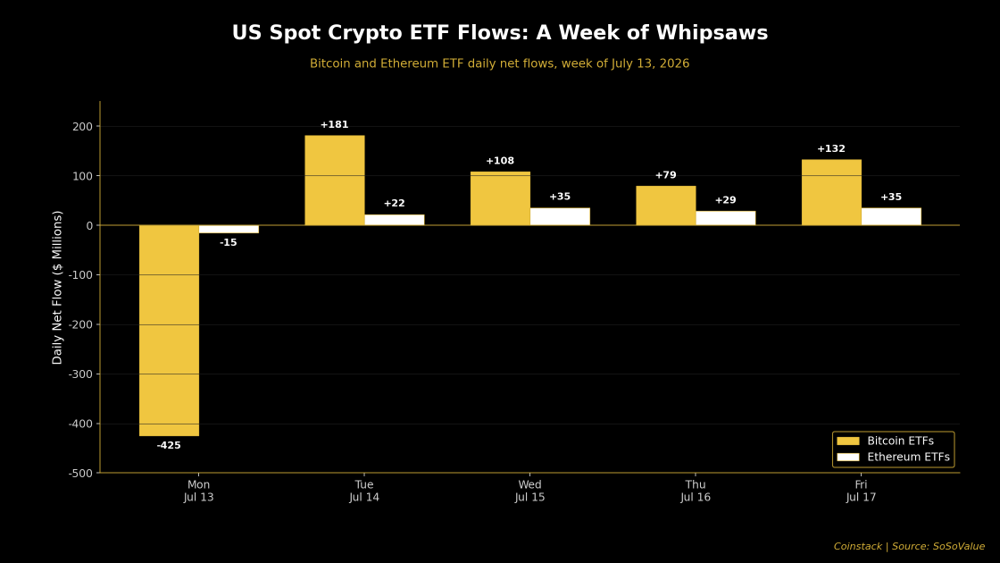
Spot Bitcoin ETFs closed the week with $75.67 million (July 17) in net inflows despite Monday’s $424.66 million (July 13) drawdown.
The GENIUS Act stablecoin rulemaking deadline passed on July 18 with agencies still finalizing final texts.
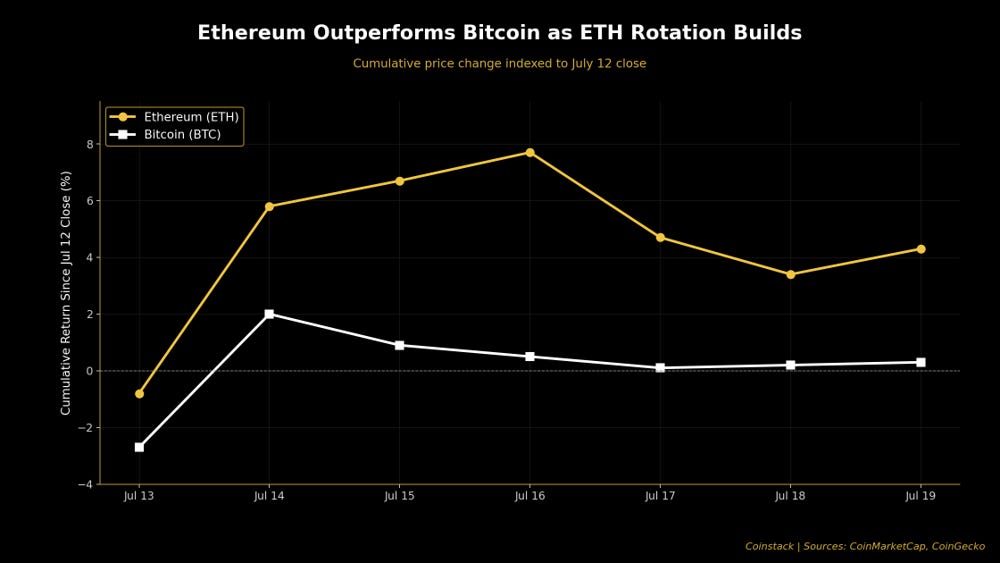
Ethereum led the week, up 4%, with ETF inflows of $105.44M compared with Bitcoin’s $75.67M (SoSoValue).
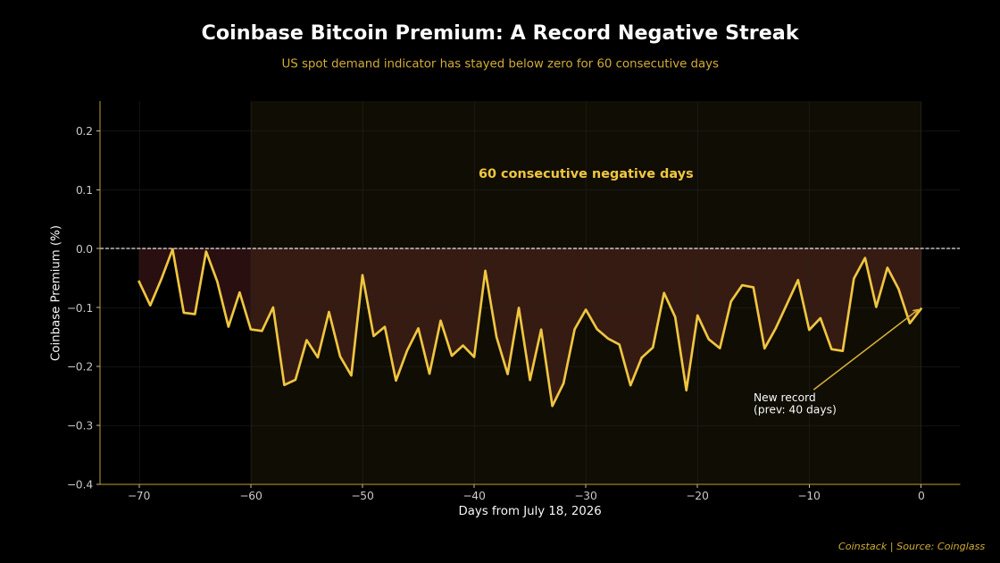
Coinbase Bitcoin Premium Index stayed negative for 60 consecutive days, setting a new record.
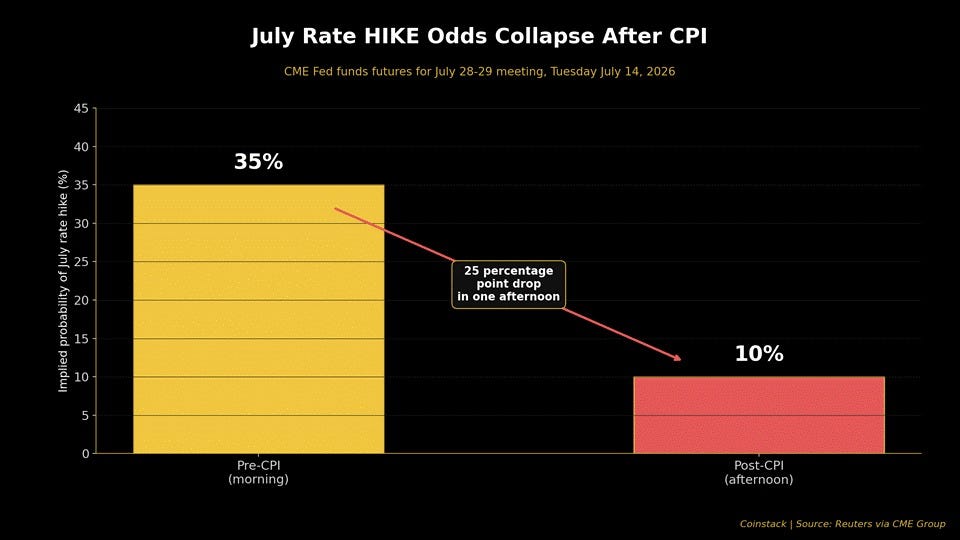
Warsh’s House and Senate testimony coincided with July rate hike odds falling from 35% to about 10% on CME Fed funds futures following the soft CPI print.
Week ahead: All eyes on the July 28-29 FOMC decision and the first wave of finalized GENIUS Act stablecoin rules.
1. Weekly Opening Insight
Crypto markets spent the week caught between two forces pulling in opposite directions. On Tuesday, June CPI printed 3.5% year over year, well below the 3.8% forecast, and Bitcoin ripped from $62,000 to nearly $65,000 within minutes. Ninety minutes later, Fed Chair Kevin Warsh refused to call the print a win, framing years of above-target inflation as an unfair burden demanding a policy regime change. Markets pared Fed easing bets, and oil rose on Middle East tensions. At the same time, Bitcoin ETFs rebounded from a $424.66M outflow to end the week with $75.67M in net inflows (SoSoValue). The GENIUS Act rulemaking deadline landed on Saturday with implementation still incomplete.
Here’s what crypto investors should understand about the week ahead…
2. Weekly Market Dashboard
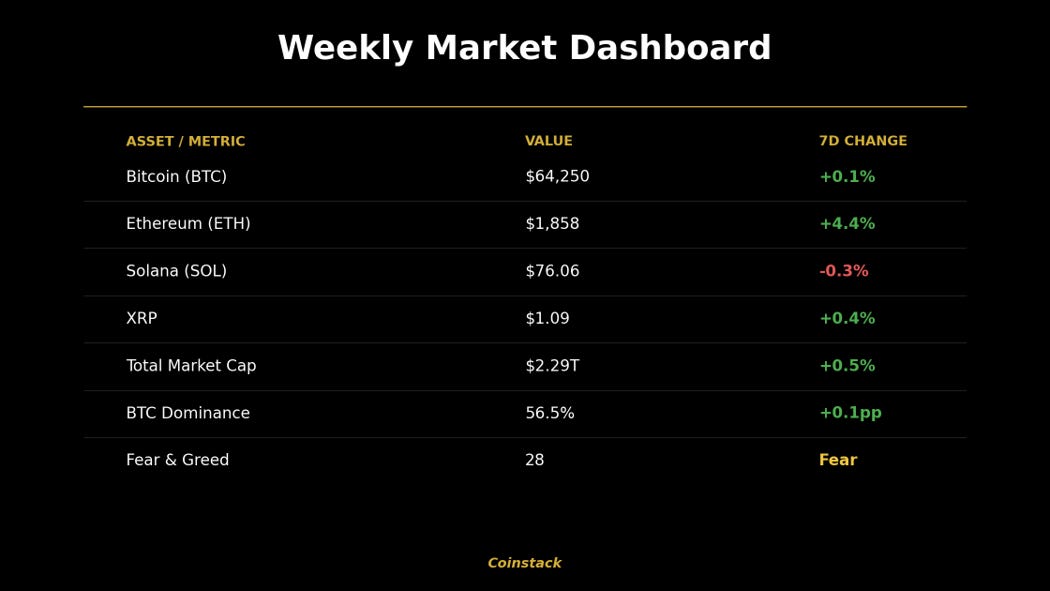
Best Performing Large-Cap: Ethereum (+2.2%)
Supported by strong spot ETF inflows of $105.44M and post-CPI momentum.
Worst Performing Large-Cap: Hyperliquid HYPE (-9% week over week)
As the token continued its pullback from its June $77 all-time high and the HYPE ETF booked $7.26M in weekly outflows (SoSoValue-July 17).
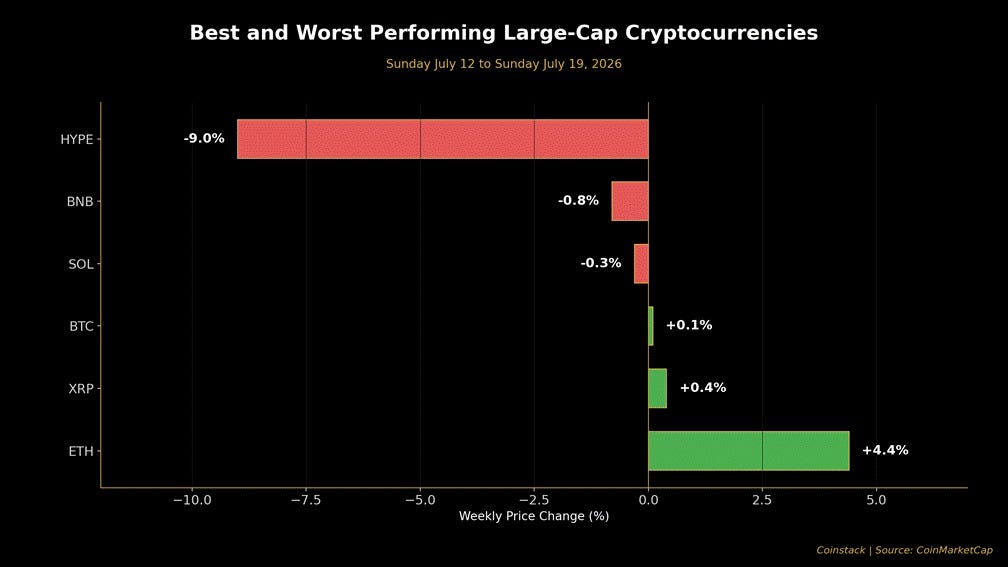
What Drove Markets This Week
Softer inflation collided with hawkish Fed rhetoric, capping upside. Renewed US-Iran tensions and concerns over the Strait of Hormuz lifted oil and Treasury yields, pressuring risk assets. Ethereum outperformed as spot ETH ETFs led crypto ETFs with roughly $105 million in weekly net inflows (SoSoValue), while T. Rowe Price formally entered the crypto ETF market.
Bitcoin Price Action: July 12 to July 19.
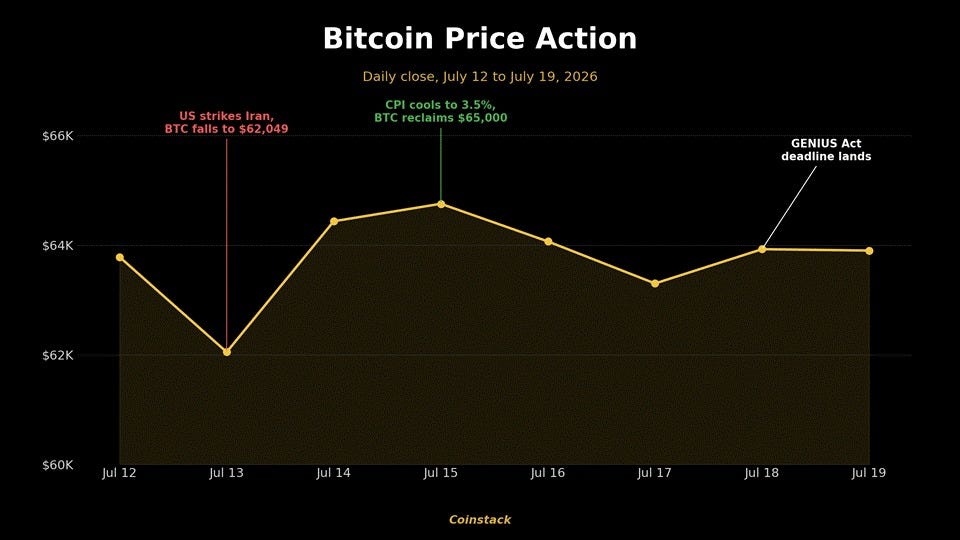
3. The Big Story of the Week
Stablecoin Framework Enters Its Final Enforcement Runway as GENIUS Deadline Lands
What happened
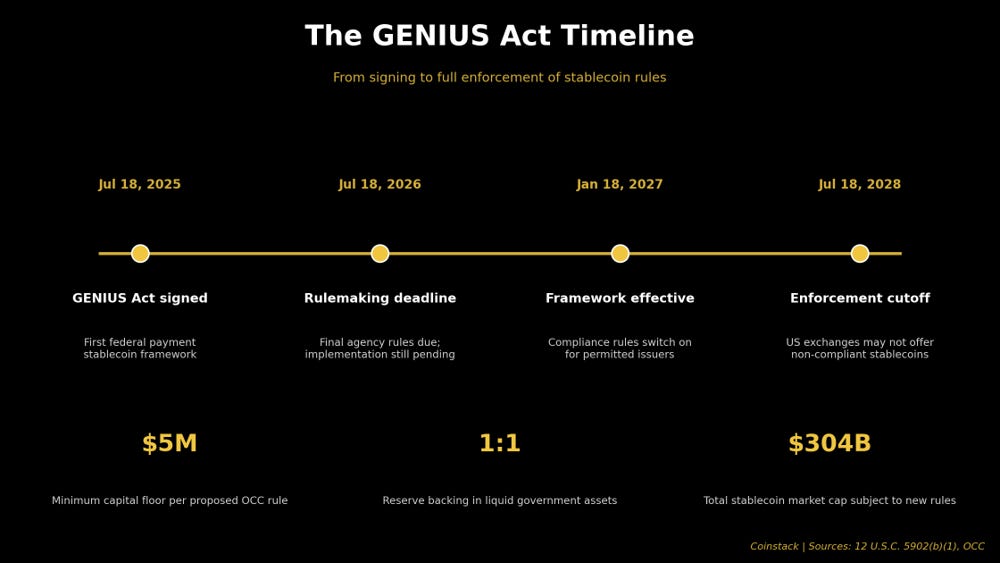
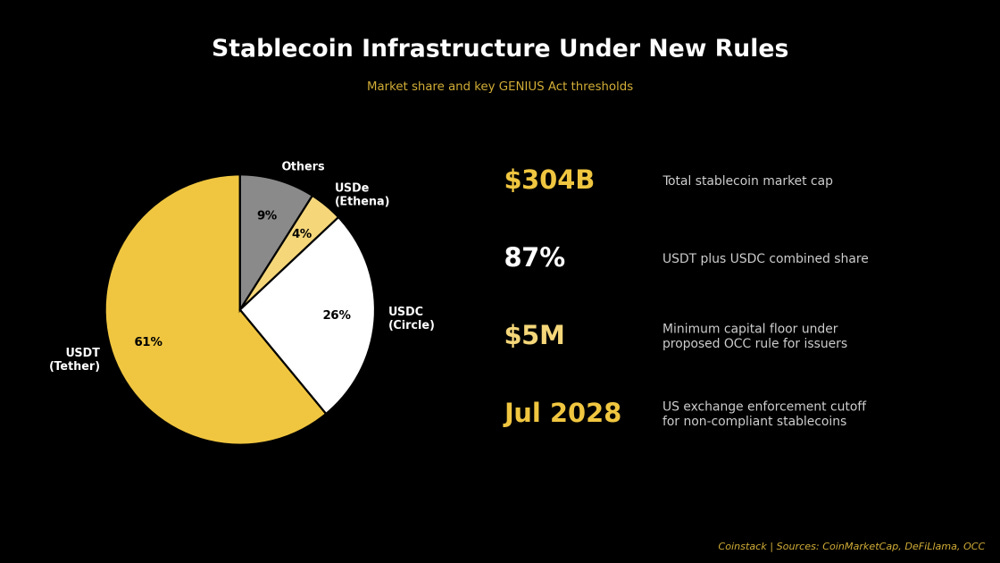
Saturday, July 18 marked exactly one year since President Trump signed the GENIUS Act into law and the statutory deadline for six federal agencies to complete the rulemaking process for payment stablecoins. A proposed framework from the OCC, FDIC, Federal Reserve, NCUA, Treasury, and FinCEN establishes the initial $5 million minimum capital floor, 1:1 reserve backing in liquid government assets, monthly independent audits, mandatory Bank Secrecy Act compliance, and a strict prohibition on paying yield to holders.
Why it matters
The framework becomes fully effective the earlier of 120 days after final rules or January 18, 2027. Fixed compliance costs are regressive by design and favor scaled issuers like USDC and USDT, accelerating market concentration. Under 12 U.S.C. 5902(b)(1), a hard July 18, 2028 cutoff prohibits US digital asset service providers from offering payment stablecoins that are not issued by permitted or qualifying foreign issuers, raising the stakes for on-chain plumbing across DeFi.
Investor takeaway
Watch for the first bank-issued stablecoin applications in August. A JPMorgan or US Bancorp filing would help define the regulatory baseline.
4. Key Market Developments
4.1 Warsh Signals Fed Regime Change After Soft CPI
What happened
June CPI printed 3.5% on July 14, the softest reading in five years, but Warsh’s House and Senate testimony that same day reframed the print as inadequate progress. Implied July rate hike odds fell from 35% to around 10% on CME Fed funds futures within hours.
Bull case
Cooling inflation removes the most immediate case for near-term tightening and leaves room for the Fed to hold or even pivot dovish later in Q3 if labor markets weaken further.
Bear case
Warsh’s no-tolerance language and December hike odds still tracking above 50% on Kalshi suggest financial conditions could tighten before easing.
4.2 Ethereum ETFs Outpace Bitcoin as Rotation Builds
What happened
Ethereum ETFs pulled in roughly $105.44 million versus $75.67 million for Bitcoin ETFs. ETH gained about 4% while BTC finished essentially flat.
Bull case
ETH led BTC into the 2022 cycle bottom, and BitMine now holds a growing share of circulating supply after adding tokens this week (PR Newswire).
Bear case
ETH still trades below $1,900, while traders watched whether it could hold above the $1,850 level into month-end.
4.3 CLARITY Act Stalls as Senate Calendar Compresses
What happened
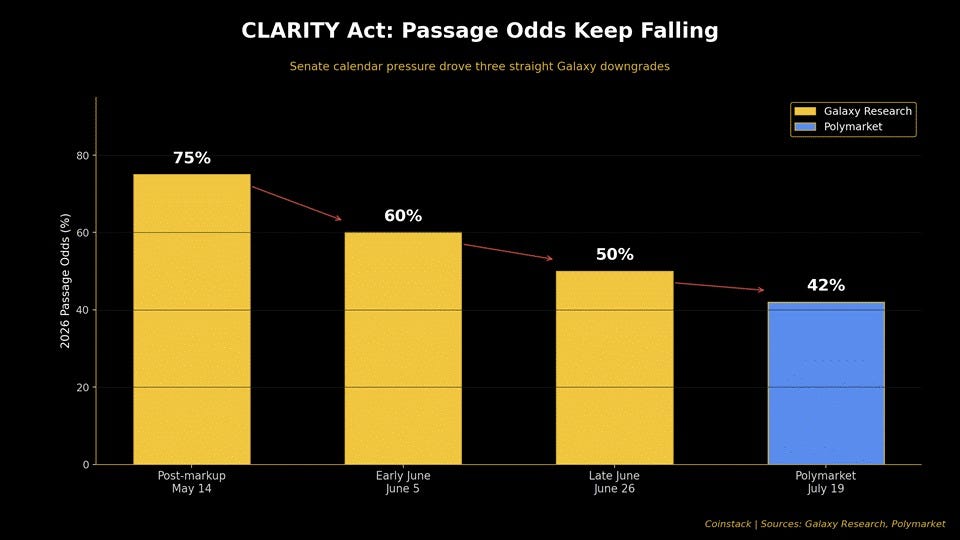
The Digital Asset Market Clarity Act remains stuck at Calendar Number 423 with no cloture motion filed. Galaxy Research has cut its estimated 2026 passage odds to 50%, down from 60% in early June and 75% after the May markup, citing a compressed Senate calendar.
Bull case
The House-passed framework remains the most advanced market structure bill in US crypto history and could still clear in September if leadership finds floor time.
Bear case
Twenty working days remain before the August 7 recess, with ethics and yield provisions still unresolved and community-bank opposition intensifying.
5. On-Chain Data Insight
The Coinbase Bitcoin Premium Index
The Data
The Coinbase Bitcoin Premium Index has stayed negative for 60 consecutive days, a new record as per Coinglass. The previous longest negative streak was 40 days.
What the Data Shows
The index measures the spread between BTC on Coinbase and BTC on Binance. A persistent negative reading means Bitcoin is trading at a discount on Coinbase relative to global spot markets.
What it might signal
Sustained negative premiums historically correlate with US retail-side weakness, muted institutional bid, or both. Meanwhile, Bitcoin whales accumulated over 270,000 BTC in two weeks per CryptoQuant. Structural US spot weakness paired with quiet whale accumulation has often preceded turning points, though rarely for this long.
6. Narrative Watch
Ethereum Leadership
Why it’s gaining attention
ETH ETFs led combined crypto ETF flows, outperforming spot Bitcoin ETFs and attracting 39% more net inflows ($105.44M vs. $75.67M) during the week (SoSoValue). Fresh Ethereum wallets accumulated roughly 50,000 ETH during the week, while the ETH/BTC ratio climbed about 6%.
Why it could grow
Ethereum has historically led broader crypto recoveries, as it did in 2022. Institutional treasury accumulation continues, with BitMine now controlling nearly 5% of circulating supply. GENIUS Act clarity supports Ethereum’s positioning as the settlement layer for regulated stablecoins.
Why it could fade
ETH trades roughly 62% below its August 2025 all-time high near $4,946. Layer 2 fee capture continues to pressure ETH mainnet revenue. A hawkish Fed extends the tightening backdrop, pressuring smart contract platforms.
7. Investment Theme of the Week
Stablecoin Infrastructure
Thesis
The GENIUS Act framework transforms stablecoins from experimental instruments into regulated infrastructure with a defined moat. Compliance burdens favor issuers with capital, custody, and audit capacity, while yield prohibitions redirect economic value toward reserves and treasury management.
Catalysts
The first bank stablecoin applications, expected in August, will set the compliance baseline. Visa’s enterprise-grade VSP platform now reaches about 15,000 financial institutions and over 200 million merchants. Marex became one of the first traditional clearing firms to accept USDC as initial margin for regulated US derivatives clearing.
Risks
Final rules may deviate from proposed frameworks. Yield restrictions could push retail toward tokenized money market alternatives. Cross-border regulatory arbitrage remains unresolved until the July 2028 exchange cutoff.
8. Smart Crypto Insight
Reading the Coinbase Premium Index
The Coinbase Premium Index compares Bitcoin’s spot price on Coinbase against its price on Binance. When Coinbase trades higher, US investors are paying up for exposure; when lower, either US selling is dominant or global demand is stronger.
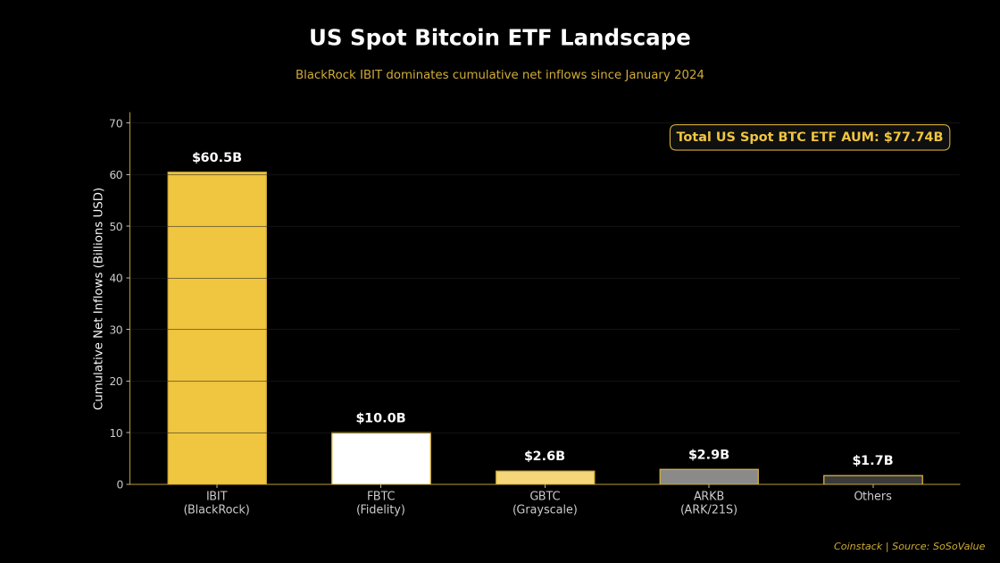
The index matters because Coinbase is the primary onramp for US retail and clears most US-regulated institutional spot flow. A structurally negative premium suggests that even with $77.74 billion in US spot Bitcoin ETF assets under management, daily US spot participation has weakened. Traders watch inflections, not absolute readings; a move from negative to neutral has historically preceded short-term BTC strength.
9. Quick Hits from the Week
FTX begins its fifth creditor distribution of approximately $900 million on July 31 for convenience and non-convenience claimholders.
A dormant Bitcoin whale moved $383 million on July 16 after over eight years of silence, routing to a new wallet rather than an exchange.
Cardone Capital added 10.5 BTC from July cash flow, pushing treasury holdings past 2,700 BTC.
Hyperliquid recorded a 2026 open interest high of $11.07 billion (according to DeFiLlama), driven by HIP-3 tokenized asset markets.
Circle signed an MOU with Japan’s JCB to explore stablecoin payments for its global merchants.
10. Closing Macro Thought
This week rebuilt the case that crypto no longer trades on its own catalysts. The largest single-day moves came from a CPI print, Fed testimony, and Middle East headlines. Even the ETH leadership narrative traces to institutional rotation more than any Ethereum-specific driver.
Investors positioning for the second half of 2026 should size expectations against a Fed that has publicly closed the door on dovish surprises, a Congress running out of working days, and a market where large holders accumulate quietly while ETFs do the loud work of setting daily prices.
Coinstack is published every Tuesday. Nothing in this newsletter constitutes financial or investment advice. All information is sourced from publicly available data and should be independently verified.
© 2026 Coinstack. All rights reserved.