
CLARITY Act Clears Senate Committee
Where Crypto Capital Flows Meet Market Intelligence.
🗓️ Tuesday, May 19, 2026 | Est. read time: 8 minutes
TL;DR
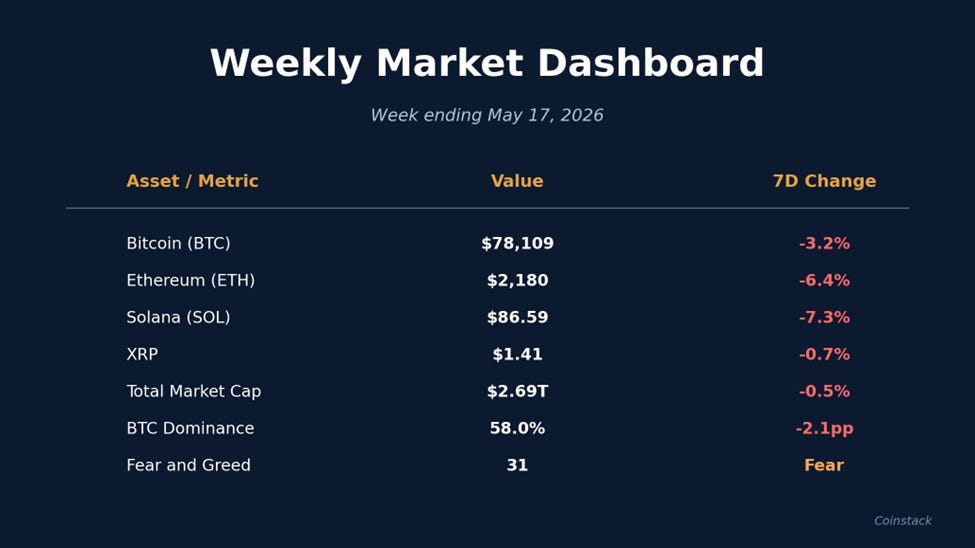
Bitcoin closed at $78,109, down 3.2%, as hot CPI and rising global yields erased the prior week’s gains.
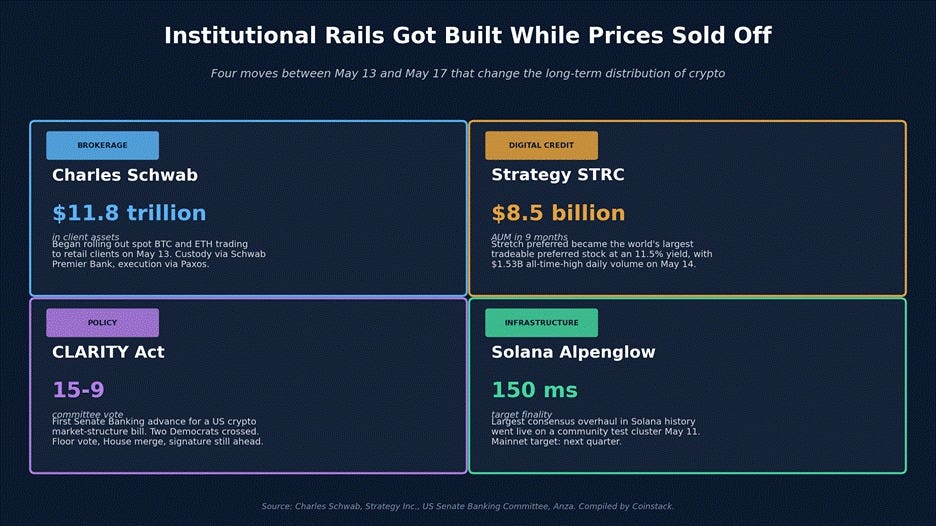
The Senate Banking Committee passed the CLARITY Act 15-9 on Thursday, the first US market-structure bill ever to clear that committee.
Charles Schwab began rolling out direct spot Bitcoin and Ethereum trading on May 13, opening crypto inside an $11.8 trillion brokerage.
Strategy’s STRC preferred crossed $8.5 billion in market cap, the largest tradable preferred in the world.
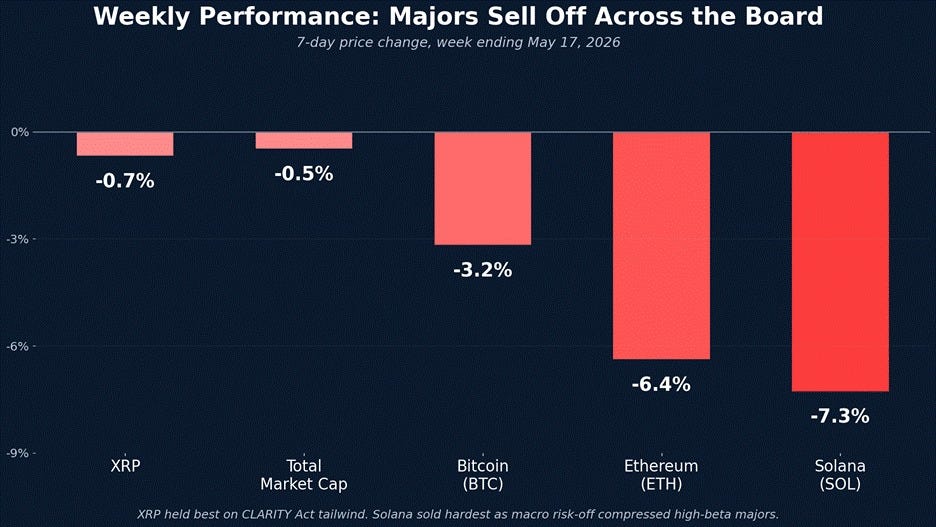
Over $581 million in crypto positions were liquidated on Saturday, with 95% on the long side, as Bitcoin slid below $78,000.
Solana’s Alpenglow consensus overhaul went live on a community test cluster, targeting 150-millisecond finality.
Week ahead: Senate floor positioning on CLARITY, Chair Warsh’s first Fed remarks, and the Q1 PCE deflator.
1. Weekly Opening Insight
Two storylines collided this week, and the macro one won the tape. CLARITY cleared Senate Banking, Schwab opened spot crypto trading, and Strategy’s STRC became the largest tradable preferred in the world. Each is a structural win for crypto’s capital base. Yet Bitcoin still closed down 3.2% because April CPI of 3.8% sent the US 10-year through 4.5%, oil through $105, and Fed rate-hike odds for year’s end above 40% after a hot PPI print mid-week. Saturday’s $581 million long liquidation cascade punctuated a week where crypto traded like a high-beta macro asset, not a hedge against one.
Here’s what crypto investors should understand about the week ahead…
2. Weekly Market Dashboard
Best Performing Large-Cap: XRP (-0.7%)
XRP held best at $1.41, supported by a 5% rally on Thursday after CLARITY advanced. Desks see XRP as one of the cleanest beneficiaries of US market-structure legislation, with ETF inflows continuing through May.
Worst Performing Large-Cap: Solana (-7.3%)
Solana closed at $86.59 after running into the same macro wall that hit every high-beta major. Alpenglow test progress and a $26.5 million SOL ETF inflow on May 14 were not enough to offset bond yield repricing and the Saturday flush.
What Drove Markets This Week
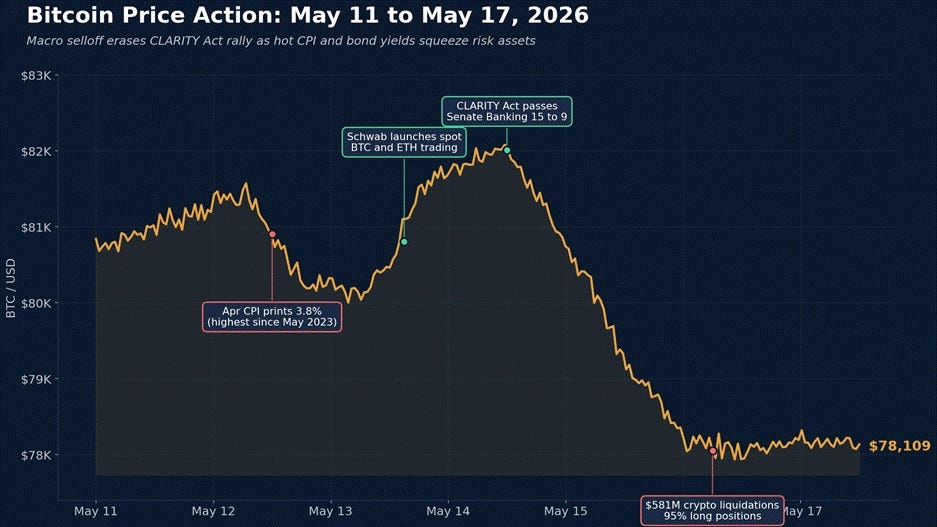
Three forces shaped the tape. Tuesday’s April CPI printed 3.8% annual inflation, the highest since May 2023, with energy up 17.9% over twelve months. The US 10-year cleared 4.5%, and the Japanese 30-year touched 4% for the first time in modern history. Thursday’s 15-9 CLARITY vote briefly lifted prices before the macro selloff resumed. By Saturday, leverage flushed, and Bitcoin printed $78,050.
Bitcoin Price Action: May 11-17.
3. The Big Story of the Week
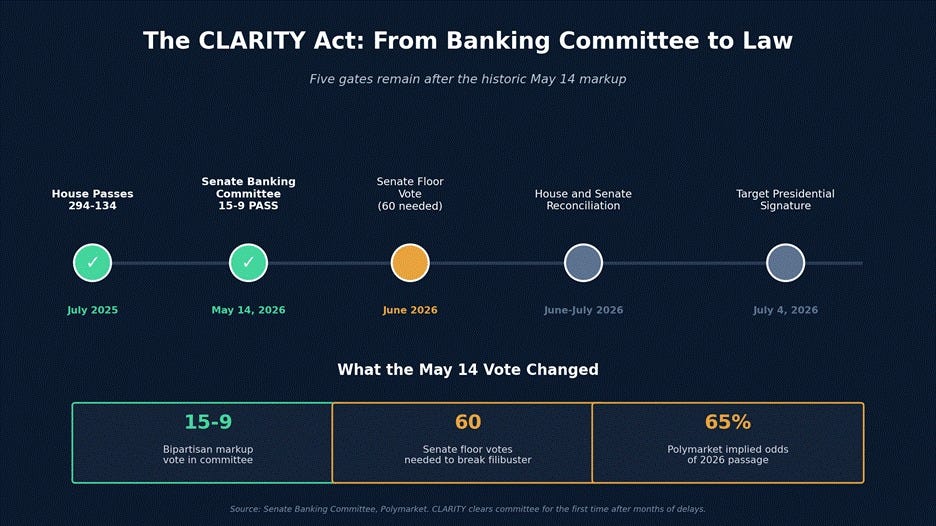
Senate Banking Passes the CLARITY Act 15-9
What happened
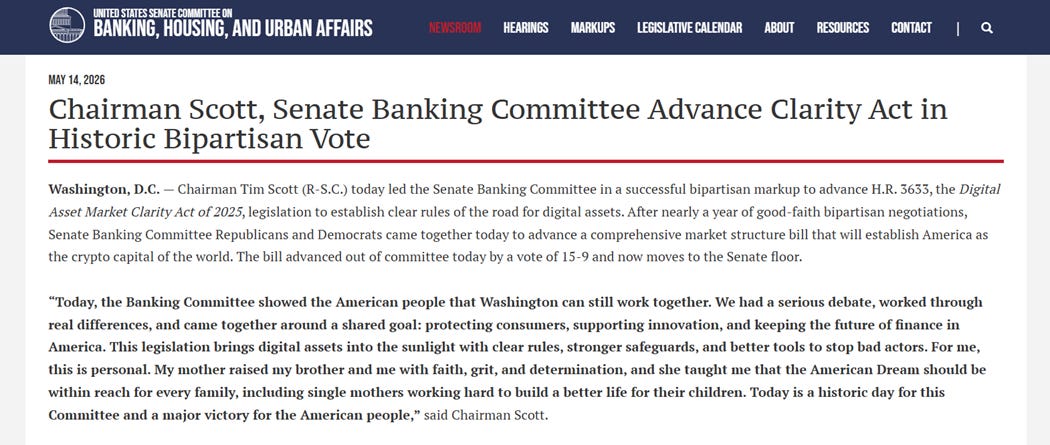
On Thursday, after roughly six hours of debate and dozens of amendments, the Senate Banking Committee voted 15-9 to advance the Digital Asset Market Clarity Act to the full Senate. All 13 Republicans voted yes, joined by Senators Ruben Gallego and Angela Alsobrooks. The bill defines the boundary between digital commodities under the CFTC and digital securities under the SEC, establishes rules for stablecoin issuance, and adopts the Tillis-Alsobrooks yield compromise.
Why It Matters
This is the first US crypto market-structure bill ever to clear Senate Banking. The math now resets: 60 floor votes are needed, meaning seven Democrats assuming every Republican holds. The White House targets a July 4 signature. Polymarket odds for 2026 passage rebuilt to roughly 65%. The Van Hollen ethics amendment failed 11-13, leaving the biggest unresolved issue heading to the floor.
Investor Takeaway
Watch three things. First, the whip count on the seven needed Democratic votes, particularly Mark Warner and Senate moderates. Second, the Van Hollen ethics question. Third, the cleanest equity reads remain Coinbase, Circle, and Robinhood, with XRP, Solana, and Hyperliquid as the on-chain proxies.
4. Key Market Developments
Charles Schwab Launches Spot Bitcoin and Ethereum Trading
What Happened
Schwab began rolling out direct spot BTC and ETH trading on May 13. Custody sits at Schwab Premier Bank, execution via Paxos.
Bull Case
A firm with $11.8 trillion in client assets adding crypto inside the same view as stocks and bonds is the cleanest distribution unlock since spot ETFs.
Bear Case
0.75% fees sit above crypto-native exchanges, the rollout excludes New York and Louisiana, and the macro tape is unfriendly.

Strategy’s STRC Becomes the World’s Largest Tradeable Preferred
What Happened
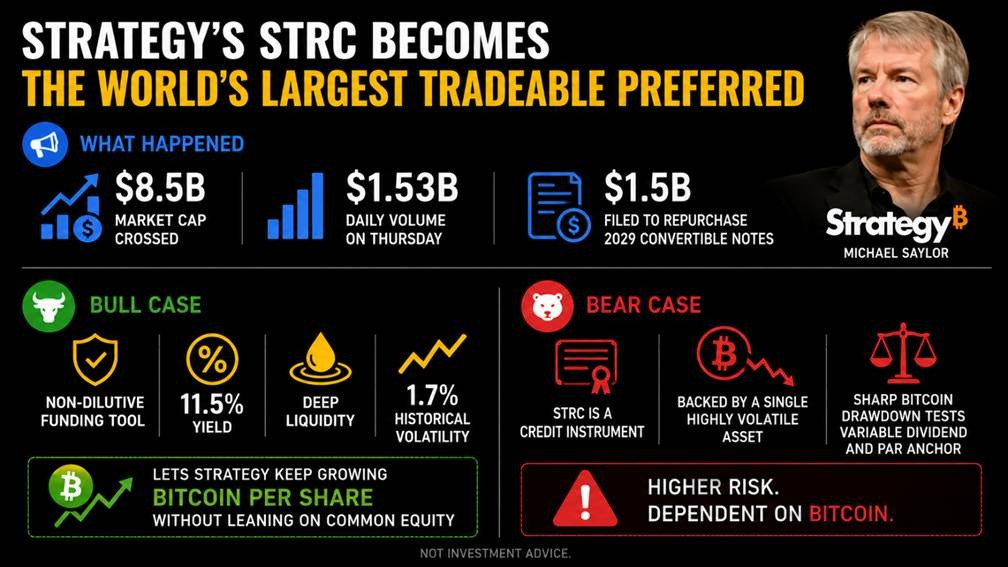
Strategy’s Stretch Preferred crossed $8.5 billion in market cap and hit $1.53 billion of daily volume on Thursday. The company also filed to repurchase $1.5 billion of 2029 convertible notes.
Bull Case
A non-dilutive funding tool yielding 11.5%, with deep liquidity and roughly 2.2% 30-day volatility, lets Strategy keep growing Bitcoin per share without leaning on common equity.
Bear Case
STRC is a credit instrument backed by a single highly volatile asset. A sharp Bitcoin drawdown still tests the variable dividend and the implied par anchor.
Hot CPI Resets the Fed Path
What Happened
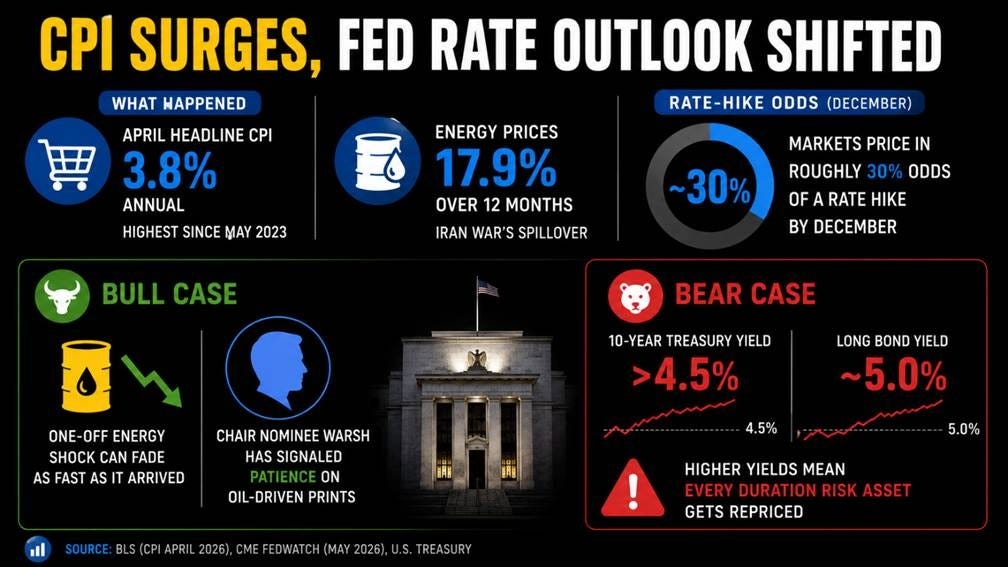
April headline CPI rose 3.8% annual, the highest since May 2023, with energy up 17.9% on the Iran war’s spillover. December rate-hike odds moved above 40% after a hot PPI print mid-week.
Bull Case
A one-off energy shock can fade as fast as it arrived, and Chair nominee Warsh has signaled patience on oil-driven prints.
Bear Case
With the 10-year above 4.5% and the long bond near 5%, every duration risk asset gets repriced.
5. On-Chain Data Insight
A One-Sided Flush in the Derivatives Stack
The Data
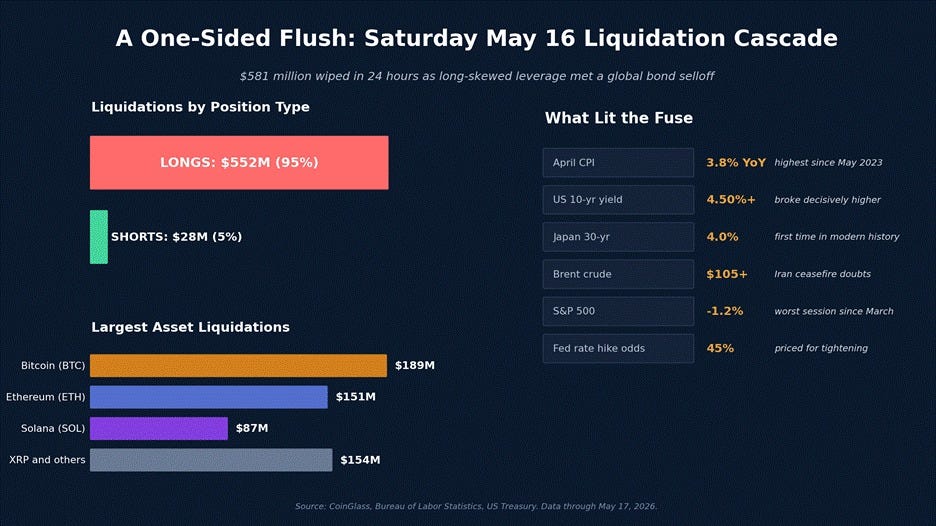
On Saturday, May 16, $581 million in crypto positions were liquidated in 24 hours, with $552 million on longs and $28 million on shorts. The largest single liquidation was a $21.6 million BTCUSDT position on Bitget. Bitcoin took the biggest hit at $189 million, and Ethereum at $151 million.
What it Might Signal
A 95% long skew on a $581 million flush is the signature of a leverage-driven move, not a spot capitulation. Open interest had built up on the long side through the CLARITY rally, and the macro pivot caught everyone the same way. Saturday liquidity is thin by design. When the cleanup is this lopsided, the next leg often comes from positioning normalizing, not new selling.
6. Narrative Watch
Wall Street Distribution Becomes the New Bitcoin ETF
The Narrative
The 2024 spot ETF launch built a wholesale rail for institutional crypto. The 2026 story is the retail rail. Schwab’s direct BTC and ETH trading lands on an $11.8 trillion brokerage. Fidelity runs spot crypto through its retail product. Robinhood and Coinbase compete at the price-taking end. JPMorgan is preparing a tokenized money market fund.
Why It’s Gaining Attention
Spot ETFs sit in retirement and pension portfolios. They do not solve crypto within a standard brokerage view alongside S&P 500 ETFs. Schwab does.
Why It Could Grow or Fade
Growth case: Even a 0.5% allocation across Schwab’s brokerage base implies tens of billions of new spot demand over twelve months. Bank distribution scales faster than ETF allocation once the pipes are live.
Fade case: 0.75% fees, state-level exclusions, and the macro tape can blunt early flows. Distribution unlocks are easy to overestimate in the first month.
7. Investment Theme of the Week
The Liquid-Credit Bridge to Bitcoin
Thesis
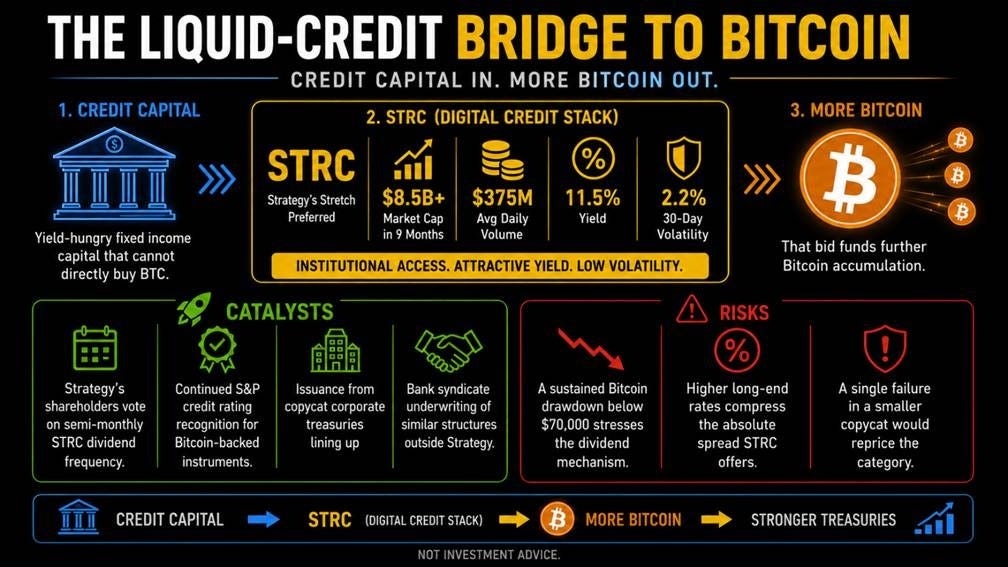
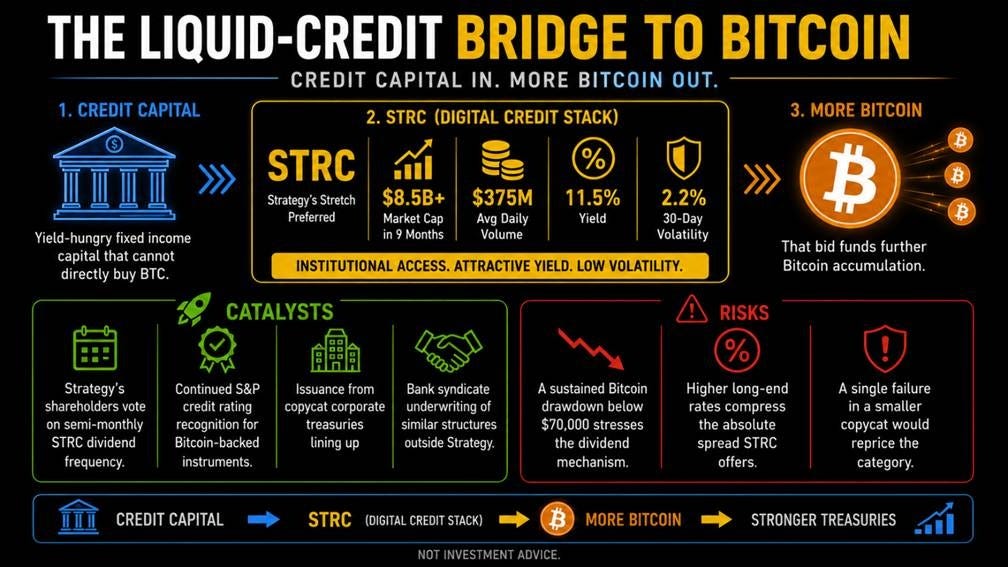
The fastest-growing institutional access point to Bitcoin this cycle is not the ETF. It is the digital credit stack built on corporate Bitcoin treasuries. Strategy’s STRC crossed $8.5 billion in nine months at an 11.5% yield, with $375 million in average daily volume and 30-day volatility near 2.2%. Yield-hungry fixed income capital that cannot directly buy BTC is buying STRC. That bid funds further Bitcoin accumulation, pulling credit capital into crypto without ever touching an exchange.
Catalysts
Strategy’s shareholders vote on a semi-monthly STRC dividend frequency.
Continued S&P credit rating recognition for Bitcoin-backed instruments.
Issuance from copycat corporate treasuries lining up.
Bank syndicate underwriting of similar structures outside the Strategy.
Risks
A sustained Bitcoin drawdown below $70,000 stresses the dividend mechanism.
Higher long-end rates compress the absolute spread STRC offers.
A single failure in a smaller copycat would reprice the category.
8. Smart Crypto Insight
Why ETF Concentration Is a Two-Sided Trade
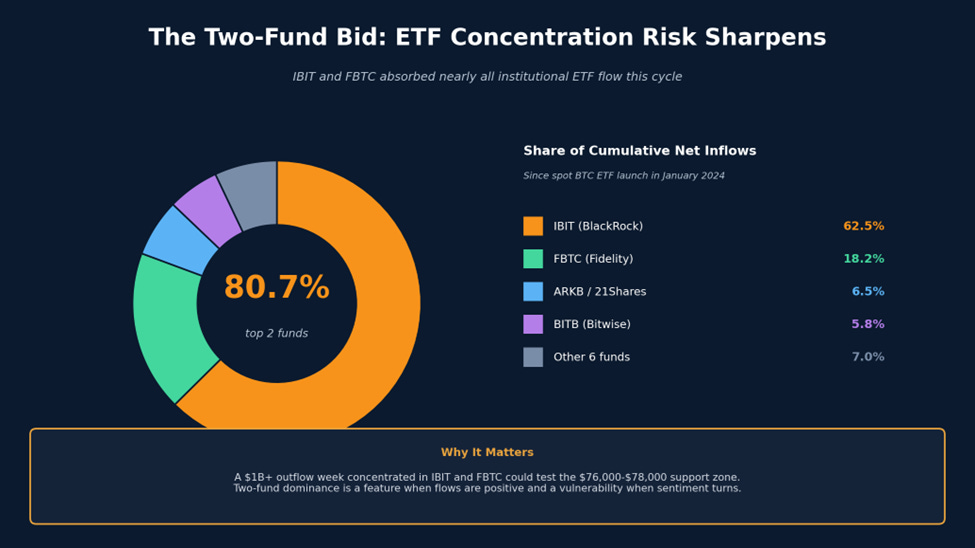
Most coverage treats Bitcoin ETF assets as a single bucket. The bid is not single. Cumulative flows since launch are roughly 62% IBIT, 18% FBTC, and 20% across the other nine funds. That two-fund dominance is a strength when flows are on. IBIT trades like SPY for Bitcoin: the default vehicle for pensions, endowments, and RIAs that need scale and liquidity at a low fee.
It is also a vulnerability. A two-fund market is a two-fund unwind. The week ending May 15 saw $1 billion in net outflows across the eleven spot Bitcoin ETFs, the worst weekly print since January after six straight inflow weeks. A $1 billion outflow week led by IBIT would test the $76,000 to $78,000 support zone directly.
The Takeaway: Track IBIT daily flows the way credit traders track high-yield ETF flows. The concentration that makes the bid efficient is what makes the unwind sharp.
9. Quick Hits from the Week
Gemini shares jumped around 20-25% on a $100 million Bitcoin-funded investment from Winklevoss Capital at $14 per share, more than 2.5x the market price.
Bhutan publicly disputed Arkham data showing $1 billion of Bitcoin leaving its sovereign wallets, saying it has not sold.
Lombard migrated $1 billion of Bitcoin-backed assets to Chainlink CCIP after the $292 million LayerZero exploit.
Spot Bitcoin ETFs recorded $1 billion in net outflows for the week ending May 15, the worst weekly print since January.
Kraken migrated its kBTC wrapped Bitcoin token to Chainlink CCIP, joining a $4 billion industry-wide exodus from LayerZero.
10. Closing Macro Thought
Crypto’s price chart told one story this week, the institutional buildout told another. Bitcoin gave back the CLARITY bid by Saturday, but CLARITY itself sits one floor vote away from a presidential signature. Schwab is now a retail crypto broker, STRC is the largest tradable preferred in the world, and Solana’s biggest consensus upgrade is running on validator infrastructure.
None of those care about a 3.8% CPI print. They care about distribution, capital structure, and throughput, three of the four variables that will set crypto’s next twelve months. The fourth is the Fed, where hot energy, sticky shelter, and a 5% long bond have erased the rate-cut path markets penciled in for the second half of 2026.
For investors, the next leg comes from the variable’s crypto controls, not the ones it can’t. CLARITY in June, Schwab flow in Q2 earnings, and Bitcoin per share growth are the readable signals. Discount rate is the one to manage around, not bet on.
Coinstack is published every Tuesday. Nothing in this newsletter constitutes financial or investment advice. All information is sourced from publicly available data and should be independently verified.
© 2026 Coinstack. All rights reserved.